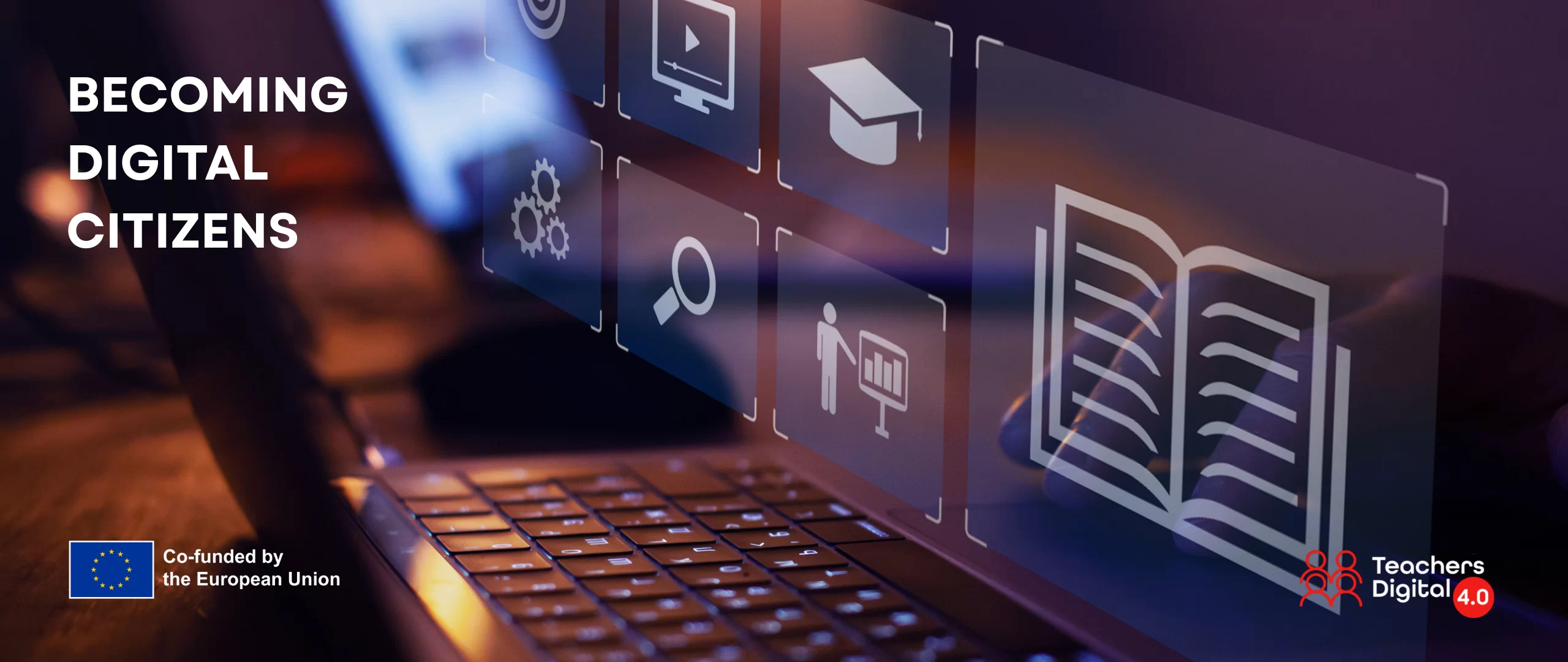
Over the past several years, the growing need for students to not simply consume media products and content, but also to be critical evaluators and ethical producers themselves, has been a primary focus of media literacy scholars and researchers. For this very reason, the module “Building Digital Media Literacy Competencies in the Classroom: Becoming Digital Citizens” from the Teachers 4.0 Digital Curriculum, was designed by EAVI – Media Literacy for Citizenship intending to equip learners with the indispensable toolkit to become responsible and critical digital citizens.
Navigating today’s digital world is becoming more complex, highlighting the need for relevant competencies to foster (digital) media literacy, as well as a foundation for informed participation in society. By integrating this module into educational settings, learners are expected to develop the ability to understand better media messages, to thoughtfully make content and take part in meaningful discussions. The learning approach is interactive, combining theory, discussion, and tasks to put the knowledge into practice.
The training is conducted in segments: first, an introduction with preparatory activities to familiarise participants with the main objectives and assess their prior knowledge, followed by theoretical sessions to unpack the frameworks of digital media literacy, which are finalised by practical exercises to apply the learned concepts. The teaching framework incorporates Bloom’s Taxonomy to build competencies progressively, encouraging students to move from remembering and understanding to being able to analyse, evaluate and create media messages. This model promotes higher-order thinking skills, which are essential for decoding media content and engaging online mindfully.
In the conceptual framework section, EAVI provides comprehensive definitions of media literacy and digital literacy, both from its inherent expertise and from broader research and institutional perspectives. Media literacy is referred to as the ability to access, analyse, evaluate and produce media messages across all media platforms, cultivating awareness as well as civic engagement (fundamental building blocks for a democratic citizenship). According to the European Commission, media literacy is interconnected with various literacies such as information, audiovisual and AI literacy, among others. It empowers learners to question media ownership and media representation, disinformation/misinformation, and to be vigilant of security, privacy, and ethical issues.
The second elaborated pillar is digital literacy, a subset of media literacy which expands this framework by focusing primarily on the technical skills needed to use digital tools to access, manage, create and share information safely and effectively. UNESCO also describes it as significant for individuals to be able to participate in social and economic processes. The EC supports this by confirming its relevance for the labour market, noting that 90% of jobs now demand basic digital skills, yet many Europeans still lack them. The module further breaks down related concepts like algorithm awareness, cybersecurity, big data, and digital divide – equally stressing the importance of netiquette, digital footprints and well-being, all of which contribute to developing responsible online habits.
Furthermore, the chapter “Becoming a Digital Citizen” presents the Media Literacy Assessment Criteria Structure consisting of two main layers, being Environmental Factors (media availability and media education and policies contexts) and Individual Competencies (social and personal competencies). The former shows how the elements in the end, namely different types of media and media education, media policies, the media industry and civil society, are main facilitators to the development of individual know-hows like critical analysis and proper usage of media technologies.
An important component of media education involves teachers, who are encouraged to embed digital media literacy into their daily lessons and act as role models for accountable digital behaviour. Ultimately, the module stresses that building digital media literacy is not just about technical competence; it’s about forming analytical, informed, righteous and actively involved citizens. Through mastering these abilities, learners can fully take part in democratic events, accurately interpret online news and information, and interact carefully with and contribute positively to their communities.
Teachers 4.0 Digital – Curriculum
As part of the Teachers 4.0 Digital project, a comprehensive university-level curriculum has been developed to help teachers and educators build their capacity in tackling disinformation and promoting digital media literacy. The curriculum is designed for both initial teacher training and ongoing professional development, empowering educators to confidently guide their students in the digital age.
The course is delivered in a blended learning format and is available in six European languages: Bulgarian, English, Greek, Italian, Polish, and Romanian. It includes 10 interactive modules covering key areas such as understanding disinformation, digital safety, assessing media literacy, inclusive teaching, and creating engaging, responsible lesson plans. The curriculum combines theory with hands-on activities, encouraging reflection, classroom application, and critical thinking, equipping teachers to foster resilient, well-informed digital citizens.
Visit the Teachers 4.0 website for all the relevant learning materials and more information about the project HERE.
Related Posts

Over the past several years, the growing need for students to not simply consume media products and content, but also to be critical evaluators and ethical producers themselves, has been a primary focus of media literacy scholars and researchers. For this very reason, the module “Building Digital Media Literacy Competencies in the Classroom: Becoming Digital Citizens” from the Teachers 4.0 Digital Curriculum, was designed by EAVI – Media Literacy for Citizenship intending to equip learners with the indispensable toolkit to become responsible and critical digital citizens.
Navigating today’s digital world is becoming more complex, highlighting the need for relevant competencies to foster (digital) media literacy, as well as a foundation for informed participation in society. By integrating this module into educational settings, learners are expected to develop the ability to understand better media messages, to thoughtfully make content and take part in meaningful discussions. The learning approach is interactive, combining theory, discussion, and tasks to put the knowledge into practice.
The training is conducted in segments: first, an introduction with preparatory activities to familiarise participants with the main objectives and assess their prior knowledge, followed by theoretical sessions to unpack the frameworks of digital media literacy, which are finalised by practical exercises to apply the learned concepts. The teaching framework incorporates Bloom’s Taxonomy to build competencies progressively, encouraging students to move from remembering and understanding to being able to analyse, evaluate and create media messages. This model promotes higher-order thinking skills, which are essential for decoding media content and engaging online mindfully.
In the conceptual framework section, EAVI provides comprehensive definitions of media literacy and digital literacy, both from its inherent expertise and from broader research and institutional perspectives. Media literacy is referred to as the ability to access, analyse, evaluate and produce media messages across all media platforms, cultivating awareness as well as civic engagement (fundamental building blocks for a democratic citizenship). According to the European Commission, media literacy is interconnected with various literacies such as information, audiovisual and AI literacy, among others. It empowers learners to question media ownership and media representation, disinformation/misinformation, and to be vigilant of security, privacy, and ethical issues.
The second elaborated pillar is digital literacy, a subset of media literacy which expands this framework by focusing primarily on the technical skills needed to use digital tools to access, manage, create and share information safely and effectively. UNESCO also describes it as significant for individuals to be able to participate in social and economic processes. The EC supports this by confirming its relevance for the labour market, noting that 90% of jobs now demand basic digital skills, yet many Europeans still lack them. The module further breaks down related concepts like algorithm awareness, cybersecurity, big data, and digital divide – equally stressing the importance of netiquette, digital footprints and well-being, all of which contribute to developing responsible online habits.
Furthermore, the chapter “Becoming a Digital Citizen” presents the Media Literacy Assessment Criteria Structure consisting of two main layers, being Environmental Factors (media availability and media education and policies contexts) and Individual Competencies (social and personal competencies). The former shows how the elements in the end, namely different types of media and media education, media policies, the media industry and civil society, are main facilitators to the development of individual know-hows like critical analysis and proper usage of media technologies.
An important component of media education involves teachers, who are encouraged to embed digital media literacy into their daily lessons and act as role models for accountable digital behaviour. Ultimately, the module stresses that building digital media literacy is not just about technical competence; it’s about forming analytical, informed, righteous and actively involved citizens. Through mastering these abilities, learners can fully take part in democratic events, accurately interpret online news and information, and interact carefully with and contribute positively to their communities.
Teachers 4.0 Digital – Curriculum
As part of the Teachers 4.0 Digital project, a comprehensive university-level curriculum has been developed to help teachers and educators build their capacity in tackling disinformation and promoting digital media literacy. The curriculum is designed for both initial teacher training and ongoing professional development, empowering educators to confidently guide their students in the digital age.
The course is delivered in a blended learning format and is available in six European languages: Bulgarian, English, Greek, Italian, Polish, and Romanian. It includes 10 interactive modules covering key areas such as understanding disinformation, digital safety, assessing media literacy, inclusive teaching, and creating engaging, responsible lesson plans. The curriculum combines theory with hands-on activities, encouraging reflection, classroom application, and critical thinking, equipping teachers to foster resilient, well-informed digital citizens.
Visit the Teachers 4.0 website for all the relevant learning materials and more information about the project HERE.
Related Posts
Over the past several years, the growing need for students to not simply consume media products and content, but also to be critical evaluators and ethical producers themselves, has been a primary focus of media literacy scholars and researchers. For this very reason, the module “Building Digital Media Literacy Competencies in the Classroom: Becoming Digital Citizens” from the Teachers 4.0 Digital Curriculum, was designed by EAVI – Media Literacy for Citizenship intending to equip learners with the indispensable toolkit to become responsible and critical digital citizens.
Navigating today’s digital world is becoming more complex, highlighting the need for relevant competencies to foster (digital) media literacy, as well as a foundation for informed participation in society. By integrating this module into educational settings, learners are expected to develop the ability to understand better media messages, to thoughtfully make content and take part in meaningful discussions. The learning approach is interactive, combining theory, discussion, and tasks to put the knowledge into practice.
The training is conducted in segments: first, an introduction with preparatory activities to familiarise participants with the main objectives and assess their prior knowledge, followed by theoretical sessions to unpack the frameworks of digital media literacy, which are finalised by practical exercises to apply the learned concepts. The teaching framework incorporates Bloom’s Taxonomy to build competencies progressively, encouraging students to move from remembering and understanding to being able to analyse, evaluate and create media messages. This model promotes higher-order thinking skills, which are essential for decoding media content and engaging online mindfully.
In the conceptual framework section, EAVI provides comprehensive definitions of media literacy and digital literacy, both from its inherent expertise and from broader research and institutional perspectives. Media literacy is referred to as the ability to access, analyse, evaluate and produce media messages across all media platforms, cultivating awareness as well as civic engagement (fundamental building blocks for a democratic citizenship). According to the European Commission, media literacy is interconnected with various literacies such as information, audiovisual and AI literacy, among others. It empowers learners to question media ownership and media representation, disinformation/misinformation, and to be vigilant of security, privacy, and ethical issues.
The second elaborated pillar is digital literacy, a subset of media literacy which expands this framework by focusing primarily on the technical skills needed to use digital tools to access, manage, create and share information safely and effectively. UNESCO also describes it as significant for individuals to be able to participate in social and economic processes. The EC supports this by confirming its relevance for the labour market, noting that 90% of jobs now demand basic digital skills, yet many Europeans still lack them. The module further breaks down related concepts like algorithm awareness, cybersecurity, big data, and digital divide – equally stressing the importance of netiquette, digital footprints and well-being, all of which contribute to developing responsible online habits.
Furthermore, the chapter “Becoming a Digital Citizen” presents the Media Literacy Assessment Criteria Structure consisting of two main layers, being Environmental Factors (media availability and media education and policies contexts) and Individual Competencies (social and personal competencies). The former shows how the elements in the end, namely different types of media and media education, media policies, the media industry and civil society, are main facilitators to the development of individual know-hows like critical analysis and proper usage of media technologies.
An important component of media education involves teachers, who are encouraged to embed digital media literacy into their daily lessons and act as role models for accountable digital behaviour. Ultimately, the module stresses that building digital media literacy is not just about technical competence; it’s about forming analytical, informed, righteous and actively involved citizens. Through mastering these abilities, learners can fully take part in democratic events, accurately interpret online news and information, and interact carefully with and contribute positively to their communities.
Teachers 4.0 Digital – Curriculum
As part of the Teachers 4.0 Digital project, a comprehensive university-level curriculum has been developed to help teachers and educators build their capacity in tackling disinformation and promoting digital media literacy. The curriculum is designed for both initial teacher training and ongoing professional development, empowering educators to confidently guide their students in the digital age.
The course is delivered in a blended learning format and is available in six European languages: Bulgarian, English, Greek, Italian, Polish, and Romanian. It includes 10 interactive modules covering key areas such as understanding disinformation, digital safety, assessing media literacy, inclusive teaching, and creating engaging, responsible lesson plans. The curriculum combines theory with hands-on activities, encouraging reflection, classroom application, and critical thinking, equipping teachers to foster resilient, well-informed digital citizens.
Visit the Teachers 4.0 website for all the relevant learning materials and more information about the project HERE.