
When Media Is No Longer “Real”: Navigating Synthetic Content and Critical AI Literacy
The quality of content we encounter in digital media is undergoing a silent but profound transformation. Images, videos, and texts are no longer produced solely by humans; automated systems, large datasets, and generative technologies have also become part of this process. This change, while increasing the speed and volume of the media landscape, is also beginning to challenge established assumptions about how content should be evaluated.Today, the "realism" of content we encounter in the digital environment says very little about how it was produced. Technical quality, visual consistency, or language fluency are no longer [...]

Learning in the Age of AI: Why Media Literacy Matters More Than Ever
The role of digital technologies in education has long been debated. First computers, then the internet, then online platforms, and now AI-powered tools… Each new wave of technology promises to transform learning processes. However, this transformation doesn't always produce the expected results. The fundamental issue we face in education today is not whether technology exists; it is how it relates to knowledge, learning, and thinking.AI-powered systems are significantly changing how students access information. Text-generating tools, automated summaries, recommendation systems, and personalised learning platforms are speeding up both the presentation and use of information. This [...]

Beyond the Screens: Generations, Trust, and the Future of News
In the digital environment, access to information has reached unprecedented levels of speed and scale. News, comments, images, and claims can reach millions of users almost simultaneously. However, this intense circulation does not guarantee the reliability of information. On the contrary, false and misleading content can spread at the same speed and with the same visibility. This makes disinformation a structural problem rather than an individual error.For a long time, the fight against disinformation was based on individual awareness. Users were expected to check sources, question content, and think critically. While this approach was [...]

Democracy in the Age of Deepfakes: How Can We Still Trust What We See?
The rise of Artificial Intelligence (AI) has introduced a new dimension to the information landscape, enabling the creation of fabricated videos, images, and voices that convincingly imitate reality. Known as “deepfakes”, these synthetic media forms have become increasingly sophisticated and accessible, prompting concern among European policymakers and citizens alike. While they may once have appeared as online jokes or curiosity pieces, they now pose a serious threat to democratic trust across Europe. In the lead-up to elections, during conflict, or in everyday social media use, manipulated content can spread fast, eroding confidence in [...]
Building Digital Media Literacy Competencies in the Classroom: Becoming Digital Citizens
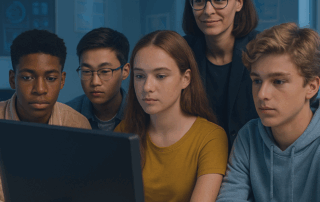
Over the past several years, the growing need for students to not simply consume media products and content, but also to be critical evaluators and ethical producers themselves, has been a primary focus of media literacy scholars and researchers. For this very reason, the module “Building Digital Media Literacy Competencies in the Classroom: Becoming Digital Citizens” from the Teachers 4.0 Digital Curriculum, was designed by EAVI - Media Literacy for Citizenship intending to equip learners with the indispensable toolkit to become responsible and critical digital citizens. Navigating today's digital world is becoming more complex, [...]

When Convenience Costs: AI Tools and the Decline of Critical Thinking
A recent study by the Massachusetts Institute of Technology (MIT) Media Lab on the impact of ChatGPT on the human brain, published in June 2025, has not gone unnoticed by media professionals and media consumers – and that is rightly so. MIT neuroscientists conducted a study on 54 volunteer MIT undergraduates and postdoctoral researchers (aged 18 to 39), who were required to write essays with and without the assistance of ChatGPT to assess its influence on their neural activity (Belot, 2025). In order to meet this goal, they used EEG headsets that effectively measure [...]
Artificial Intelligence: A Double-edged Sword
It can play chess, give you a diagnosis, drive your car, talk to you as a customer service representative, detect fraud, and tell you what you like based on your recent Netflix activity. It is artificial intelligence. But what is it exactly? How did it enter our lives so quickly, and what does it imply for our future? Let's dive into the long-discussed topic of AI and try to find an answer to these questions. Briefly, artificial intelligence is a ‘thinking’ machine that responds in a way that mimics human cognitive processes and generates [...]

Are you aware of your Digital Footprint?
Recently, EAVI and the European Digital Learning Network (DLEARN), in collaboration with Prof. Przemek Sękalski of the Technical University of Lodz, worked together in developing an EU survey that analyses citizens awareness regarding their digital footprint. The survey aims to analyse how much control participants exercise over this digital footprint and how much control they wish they could have as well are looking at the safety aspects they would like to see in place in the future! The aim is to study the results to highlight potential areas in education and training that could be [...]

How Media Literacy and Sustainability Go Hand in Hand
Besides the tremendous heat wave we are experiencing these weeks, there are many things that encourage my reflection on climate change these days. But beyond focusing only on the disastrous consequences of decades of reckless activities harmful to our environment, I like to discover new ways in which people are creating a positive impact. How do I find about this? Well, word of mouth is of course part of it, but most movements I have discovered-- and maybe so have you-- have been from the hours I spend constantly scrolling online. Technology and digital communications [...]

Fake news and critical literacy in the digital age: sharing responsibility and addressing challenges
How can we tackle the ongoing challenge of so-called ‘fake news’? Gianfranco Polizzi, PhD Researcher in the Department of Media at Communications at LSE, argues that we all have a responsibility to learn critical literacy to help us better to evaluate information, both on- and offline, and here sets out the responsibilities held by the different actors involved. This post was first published on the London School of Economics' Media Policy Project Blog on May 21, 2018. Social inclusion and democratic participation rely on opportunities to access, express and share information as citizens. The extent to [...]