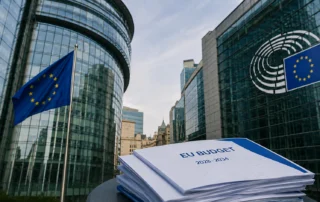
EAVI’s work in promoting Media Literacy in the next EU budget
11/06/2026 EAVI has been actively working in recent months to guarantee that the perspectives of the media literacy community and civil society organisations are represented in the debate on the priorities of the next budget. It is a long process, implying varied advocacy activities at EU level including attendance of Committee sessions and public hearings, meetings with Members of the European Parliament, other EU officials, drafting policy papers and amendments. To provide some context, the European Union relies on a multiannual financial framework (MFF), which is renewed every seven years. The European Commission [...]

What We Learned from 8 Conversations About AI and Media Literacy: What We Can All Do, According to the Experts
9/06/2026 How can media literacy strategies help safeguard citizens in an AI-driven information ecosystem? How have social media algorithms transformed the way information spreads? How can we ensure that AI aligns with human values and ethical principles? What does it mean to use AI responsibly? We explored these questions, among others, in the latest series of the EAVI Conversations podcast. In this article, we share some of the key lessons that emerged from our conversations with experts. From questioning the information we encounter online and reflecting critically on our use of AI, to [...]
8 Things Experts Want You to Know About AI and Media Literacy: EAVI’s Conversations 4
9/06/2026 In the latest series of the EAVI Conversations podcast, we explore why media and information literacy has become indispensable in an age shaped by algorithms and artificial intelligence. These conversations dive into the challenges AI poses for democracy, media freedom, education, and access to information. From the importance of explainability in AI and platform design, to the role of human agency in an increasingly automated environment, they examine what is needed to ensure that technological development serves the public interest, and how citizens, policymakers, educators, and technology developers can work towards [...]
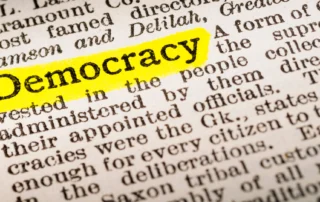
The European Democracy Shield: an ambitious strategy?
27/05/2026 During her State of the Union speech in 2024, European Commission President Ursula Von der Leyen declared, “Our democracy is under attack. The rise in information manipulation and disinformation is dividing our societies. It is not only eroding trust in the truth – but also in democracy itself. This is why we urgently need the European Democracy Shield. We need more capacity to monitor and detect information manipulation and disinformation. So, we will set up a new European Centre for Democratic Resilience. This will bring together all the expertise and capacity across Member States [...]

ChatGPT assisted Summary of 7 recent media articles by Tapio Varis
11/05/2026 Worldview Media Literacy and Peace Education: An Academic Synthesis Introduction The text by Tapio Varis presents a comprehensive and interdisciplinary reflection on the evolving relationship between media literacy, global communication, peace education, and cultural identity in the 21st century. Drawing on decades of academic work, international collaboration, and historical analysis, the author situates media literacy not merely as a technical skill but as a foundational component of global citizenship, ethical responsibility, and intercultural dialogue. At its core, the work argues that humanity is facing a profound transformation in communication, education, and [...]

Protecting Citizens in a changing media landscape: strengthening media literacy in the revision of the Audiovisual Media Services Directive
28/04/2026 The role of the Audiovisual Media Services Directive in promoting media literacy The Audiovisual Media Services Directive (AVMSD) came into force in 2010 and governs the EU-wide coordination of national legislation on all audiovisual media providers, namely traditional TV broadcasts and on-demand services. The goals behind an EU-wide coordination of audiovisual media include providing rules to shape technological developments, creating a level playing field for emerging audiovisual media, preserving cultural diversity, protecting children and consumers, safeguarding media pluralism, combating racial and religious hatred, and guaranteeing the independence of national media regulators. The adoption of the [...]

Democracy in the Age of Deepfakes: How Can We Still Trust What We See?
The rise of Artificial Intelligence (AI) has introduced a new dimension to the information landscape, enabling the creation of fabricated videos, images, and voices that convincingly imitate reality. Known as “deepfakes”, these synthetic media forms have become increasingly sophisticated and accessible, prompting concern among European policymakers and citizens alike. While they may once have appeared as online jokes or curiosity pieces, they now pose a serious threat to democratic trust across Europe. In the lead-up to elections, during conflict, or in everyday social media use, manipulated content can spread fast, eroding confidence in [...]

Teen Age-Verification on Social Media: Australian & European Approaches
Every generation faces new frontier problems. For today’s teens, the frontier is digital — a world of likes, shares, endless scrolling, and unseen pressures. With concerns mounting about mental health, attention spans, and the unseen harms of social media, Australia has taken an important step: a law banning social media access for under-16s. As that policy looms, the question for other countries is unavoidable: is this kind of ban effective or a misunderstanding of technology and young people? In November 2024, the Parliament of Australia passed a world-first law prohibiting youth in early adolescence [...]

MINDS & TRUST
As we look at the campaign for the US elections, an alarming trend is clear: the infantilisation of voters. Instead of meaningful discussions, we see debates reduced to catchy slogans and personal stories designed to trigger emotions rather than encourage evaluation and thinking. In Europe, we see a similar pattern with the far right making gains. Short, out-of-context videos are being used to personally attack candidates rather than to engage with their ideas, and we are inundated with news about violence designed only to generate anxiety and unjustified fear. Is this really what we [...]
The Rise of Antidemocratic Far Right, Propaganda and Disinformation
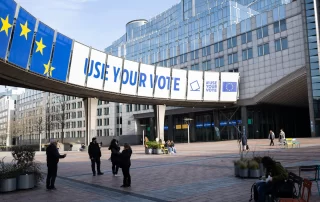
The European Parliament Elections resulted in a significant shift as the extreme right gained substantial ground. With 220 seats, extreme right parties currently make up almost one-third of the parliament, while Greens and Socialist Democrats have lost 18% and 3% of their seats, respectively. Far-right parties have been persistently targeting younger voters with success. A video that was posted on the social media platform X just a few weeks before the elections, where a group of German youth chanting 'Germany for Germans, foreigners out!' went viral. In the Flemish region of Belgium, Flemish [...]